Tuesday, June 1, 2010

Monday, May 17, 2010
Wednesday, May 12, 2010
May 12th Math Class a.k.a. 13 days until Kayla's birthday!!
First we started off having open revision time. We did problems, used Mr. O'B, and avoided second semester senior distractions :-).
Next we went over the HW Quiz. This showed that the ambiguous case is something we all may need to go over before the test. Know the rules for the ambiguous case and how to find values for b to make the triangle have a. one solution b. two solutions and c. no solution. In order to have a triangle the third side has to be between the sum and difference of the other two sides. For the example if a=9 and b=13 c has to be between 22 and 4.
The test covers: Chapter 5&6. Page 419 has a list of topics in chapter 5 that we need to know. We will be given sum/difference formulas, so no need to memorize. Section 5.5 all the bullets are on the test except for the second and the fourth bullet. It's a very doable test, just learn the basics. There aren't going to be that many finally crafted, so get the basics down. Page 481 tells what's on the test for chapter 6. 6.1Know the law of sines and area. 6.2 Know the law of cosines and the Heron's area formula. 6.3 know all. 6.4 know the dot product formula. Try to memorize all of the formulas but if not Mr. OB may help us. We will get the vector projection formula. We do not need to know the last bullet on 6.4 and 6.5 will not be on the test.
Last we finished up with doing problems and practicing our skills.
Remember study hard for the test on Monday. Put all of your homework together, corrected, marked, and in order.
Next scribe: Angus P.
Next we went over the HW Quiz. This showed that the ambiguous case is something we all may need to go over before the test. Know the rules for the ambiguous case and how to find values for b to make the triangle have a. one solution b. two solutions and c. no solution. In order to have a triangle the third side has to be between the sum and difference of the other two sides. For the example if a=9 and b=13 c has to be between 22 and 4.
The test covers: Chapter 5&6. Page 419 has a list of topics in chapter 5 that we need to know. We will be given sum/difference formulas, so no need to memorize. Section 5.5 all the bullets are on the test except for the second and the fourth bullet. It's a very doable test, just learn the basics. There aren't going to be that many finally crafted, so get the basics down. Page 481 tells what's on the test for chapter 6. 6.1Know the law of sines and area. 6.2 Know the law of cosines and the Heron's area formula. 6.3 know all. 6.4 know the dot product formula. Try to memorize all of the formulas but if not Mr. OB may help us. We will get the vector projection formula. We do not need to know the last bullet on 6.4 and 6.5 will not be on the test.
Last we finished up with doing problems and practicing our skills.
Remember study hard for the test on Monday. Put all of your homework together, corrected, marked, and in order.
Next scribe: Angus P.
Monday, May 10, 2010
May 10: Vector Projections
We spent the first 40 minutes on the quiz. This was the last homework quiz of the year!! But still make sure you're keeping up with your homework because we have a test coming up!
We then looked at the proof for the vector projection of u onto v

(I would type all of the proof except I'm not the best with that equation editor..Ask someone for notes if you need it)
Mr. OB told us that it was not necessary to memorize the proof (he'll put it on the test).
Our homework questions took up the rest of the time.
Example:
#59.
u = <3,5>
Find 2 vectors orthogonal in opposite directions
Possible answers: <-5,3>, <10,-6>
In order to be orthogonal u dot v must equal zero
Next Scribe: Kayla
We then looked at the proof for the vector projection of u onto v
(I would type all of the proof except I'm not the best with that equation editor..Ask someone for notes if you need it)
Mr. OB told us that it was not necessary to memorize the proof (he'll put it on the test).
Our homework questions took up the rest of the time.
Example:
#59.
u = <3,5>
Find 2 vectors orthogonal in opposite directions
Possible answers: <-5,3>, <10,-6>
In order to be orthogonal u dot v must equal zero
Next Scribe: Kayla
Thursday, May 6, 2010
5/6/10 - Noelle
Final New Material of PAP!!!!
Today we started off with a warm up using the first link on the blog to find the sum of vectors:
a) <3,2> + <2,4> = ? = <5,6>
b) <3,2> + <-5,1> = ? = <-2,3>
Then we worked on this problem from the book (which also answered the homework question #69)
Pg. 467 (70)
To solve this you can graph on paper or use geogebra. First you're supposed to find the magnitude of the vectors, which is  . From this you can use the pythagorean theorem to find the hypotenuse, which is
  . Then, by using the law of cosines, set up the following equation:
 %5E%7B2%7D%3D%5Cleft(%20%5Csqrt%7B5%7D%20%5Cright)%5E%7B2%7D%2B%5Cleft(%20%5Csqrt%7B5%7D%20%5Cright)%5E%7B2%7D-2%5Csqrt%7B5%7D%5Csqrt%7B5%7Dcos%5Ctheta%20) , and by solving algebraically, you get that theta is 90 when cosine of theta is 0.
, and by solving algebraically, you get that theta is 90 when cosine of theta is 0.
We went over problem 73 from the homework on page 456:
We discovered you can use vector properties OR use the law of cosines to find the answer. The answer was 398.32 lbs of force at a 12.8 degree angle.
(make sure to try and memorize the formula for the law of cosines for the quiz/test coming up, unless you don't mind the sting of losing a point by asking for it)
*possible test connection, make sure you understand how to do this problem*
Dot/Scalar Multiplication:
if  " class="ee_img tr_noresize" eeimg="1" style="vertical-align: middle; "> and
  " class="ee_img tr_noresize" eeimg="1" style="vertical-align: middle; ">, then
  .
.
Scalar is a number, while a vector is a directed line segment. When Vectors are dotted (multiplied together), then they become scalars.
There are 5 Properties of Dot Multiplication that can be found in the book or with detailed explanations at: http://en.wikipedia.org/wiki/Dot_product#Properties.
Angle Between 2 Vectors:
If theta is the angle between 2 vectors, then u*v= (magnitude of u)*(magnitude of v)*cos(theta).
another way to write this is  magnitude of u)*(magnitude of v)*cos(theta).
This can be explained in more detail at this site: http://en.wikipedia.org/wiki/Dot_product#Proof_of_the_geometric_interpretation
Things to Remember:
Study for the Quiz on Monday!!!
Test on the 17th!
Supercorrections...
and then the final project!!
Homework: HW #12:
* p. 467/1, 13, 29, 33, 35, 43, 49, 53, 57, 59 (and study)
Tuesday, May 4, 2010
May 4, 2010
Today we started class with a WARM UP....
We worked on finding the component form, magnitude, and direction angle of vectors. Finding the component form of the the vectors was not too hard. Mr. O'Brien showed us a trick to help us remember how to find the component form. Terminal - Initial = Component Form.. (T-I!) Someone suggested that thinking of our super T-I 83 or 84 calculators could be a helpful reminder of how to find the component form.

Vector AB
Vector CD
Direction angle seemed to be the one part of the warm up that confused the class. We used Geogebra to help us visualize where the direction angle was.

The angle shown in both triangles is subtracted from 360˚ to find the directional angle.
That was only the first part of the warm up.....
For the second part we worked on finding the value of 3 x vector u.
Mr. O'Brien shared another helpful hint with us, he told us that if the magnitude of vector u and (theta) are given then the component form isu x cos(theta), magnitude of vector u x sin(theta)>.
Also, when a vector is multiplied by a number it is called a scalar. When the vector is multiplied by a number it is dilated geometrically.
We also looked at the result of two vectors added or subtracted, and their relation to 3(vector u) with Geogebra.

The three segments in the image above are: 3 x vector u, vector u - vector v, and vector u + vector v. The discovery that we made with Geogebra is that the three segments make up a triangle!!
We also went over the quiz that we took last class. Mr. O'brien stressed to make sure that the answer that you found while working through a problem was an answer that the question was looking for.
**Besides some silly/careless errors, Mr. O-Brien said that overall, we are showing great progress with our homework quizzes! way to go
Homework Questions.... were #59 and 61 on Pg. 456. These questions were addressed when we went over the warm up.
Keep on top of your homework! Due next class: pg. 456 #15-20, 25, 31, 43, 49, 53, 69, 73
Reminder: Quiz Monday 5/10
TEST Monday 5/17
Next Scribe: I'm not really sure who hasn't done a blog post recently... any volunteers??
We worked on finding the component form, magnitude, and direction angle of vectors. Finding the component form of the the vectors was not too hard. Mr. O'Brien showed us a trick to help us remember how to find the component form. Terminal - Initial = Component Form.. (T-I!) Someone suggested that thinking of our super T-I 83 or 84 calculators could be a helpful reminder of how to find the component form.

Vector AB
Vector CD
Direction angle seemed to be the one part of the warm up that confused the class. We used Geogebra to help us visualize where the direction angle was.

The angle shown in both triangles is subtracted from 360˚ to find the directional angle.
That was only the first part of the warm up.....
For the second part we worked on finding the value of 3 x vector u.
Mr. O'Brien shared another helpful hint with us, he told us that if the magnitude of vector u and (theta) are given then the component form is
Also, when a vector is multiplied by a number it is called a scalar. When the vector is multiplied by a number it is dilated geometrically.
We also looked at the result of two vectors added or subtracted, and their relation to 3(vector u) with Geogebra.

The three segments in the image above are: 3 x vector u, vector u - vector v, and vector u + vector v. The discovery that we made with Geogebra is that the three segments make up a triangle!!
We also went over the quiz that we took last class. Mr. O'brien stressed to make sure that the answer that you found while working through a problem was an answer that the question was looking for.
**Besides some silly/careless errors, Mr. O-Brien said that overall, we are showing great progress with our homework quizzes! way to go
Homework Questions.... were #59 and 61 on Pg. 456. These questions were addressed when we went over the warm up.
Keep on top of your homework! Due next class: pg. 456 #15-20, 25, 31, 43, 49, 53, 69, 73
Reminder: Quiz Monday 5/10
TEST Monday 5/17
Next Scribe: I'm not really sure who hasn't done a blog post recently... any volunteers??
Friday, April 30, 2010
Scribe Post April 30, 2010
We started class with a homework quiz. Mr. O'Brien said that homework quizzes are like a doctor's thermometer, and that we shouldn't really stress about them, but they can tell you how much you need to focus on the homework.
We also talked about the final a little bit, which we'll take with the seniors.
And then we took some notes...
Vector Intro
A vector is a directed line segment. There is a vertical and horizontal segment to a vector.
- The length of the vector is the magnitude
- Theta is the direction angle
Homework
29. This problem was trying to find the bearings of ships. We labeled the most of the angles, and used the law of cosines to solve for the triangle. We got C by doing the cos inverse. After finding C we used the law of sines to help solve the rest of the problem.
9. We used the law of cosines, with a^2 being on the left, and then used the law of sines.
21. There was a domain error because it was a bit too short to make a triangle, so the answer is that there is no triangle.
35. Drawing a diagram is really helpful, and then you can use the law of cosines.
The homework for next class is p. 456/3-11 odd, 57-61 odd.
We also talked about the final a little bit, which we'll take with the seniors.
And then we took some notes...
Vector Intro
A vector is a directed line segment. There is a vertical and horizontal segment to a vector.

- The length of the vector is the magnitude
- Theta is the direction angle
Homework
29. This problem was trying to find the bearings of ships. We labeled the most of the angles, and used the law of cosines to solve for the triangle. We got C by doing the cos inverse. After finding C we used the law of sines to help solve the rest of the problem.
9. We used the law of cosines, with a^2 being on the left, and then used the law of sines.
21. There was a domain error because it was a bit too short to make a triangle, so the answer is that there is no triangle.
35. Drawing a diagram is really helpful, and then you can use the law of cosines.
The homework for next class is p. 456/3-11 odd, 57-61 odd.
Wednesday, April 28, 2010
April 28, 2010: Math Class
Today, we started class off with a warmup, which utilized the Sine Rule that we practiced for homework last night. This warmup was tricky, for it gave:
A=26 (degrees)
a=5
b=8
Which from our reading last night, was the tricky A.S.S. problem. This was interesting because there were more than one triangle that is possible from these three pieces of information.
We realized that you have to be careful using the Sine Rule! We learned that you could solve for the other triangle by finding: and
and .png) . Once you find these values, you can solve just like we did in the homework.
. Once you find these values, you can solve just like we did in the homework.
We also talked about how we may be given values that do not form any triangles!
From the warmup, we learned about the dangers of the SSA triangles, for there are two triangles you have to watch out for, as long as b (or the side opposite the given angle is greater than the height, but less than the other given side.
After solving the problem, we were challenged to make an accurate representation of it on Geogebra, which was a little harder than many thought it would be.
Next, the class looked at several applets that helped us understand more about the Sine Rule, by playing around with the a, b and c values.
We learned several rules, which can be seen at this applet: http://home.comcast.net/~paulbirdsall/class/ambig.html
O triangles means that:
b < h
1 triangle means that
a. b = h
b. b > h and b > c
2 triangles means that
h < b < c
After this, we looked at several problems from the homework, mainly the word problems:
These were all hard, because there was usually a trick we had to discover in order to get the ball rolling on finding A,a,B,b and C,c. Once the trick was solved however, it was easy to follow the Sine Rule, and solve them.
Here were the tricks!
37. Find the 48 degree angle from the right triangle, then you have the crucial angle, and can easily solve for theta using the Sine Rule.
39. The parallel lines are key here. you have to look at the parallel lines, to find the alternate interior angles! Then you can fine the triangle with the added angles, which again, is the crucial answer. Easy to solve from there!
41. In this problem, you again need to look for alternate interior angles. If you look at the diagram that Mr. O'Brien drew, it is easy to see the triangle that can be used to solve b. From there you can solve for c and d easily.
43. This again, is just a matter of looking at the geometry of the problem, you simply need to find the triangel to solve for x, then you can find d!
This was most of the homework we went over, and we turned next to looking at the Cosine Rule. We derived this in a similar way to the Sine Rule. I don't think anyone was missing, so it shouldn't be a problem of getting notes from this!
It does seem a little more complicated than the Sine Rule, but we'll be spending more time on it in the coming classes, so I'm sure that with homework, and classwork, we will understand it fine.
Overall, this class was productive because we covered word problems extensively, and learned about that tricky A.S.S. problem! The homework will enforce the Cosine Rule, and any doubts will be answered in class on Friday.
Check the iCal for homework!
There's a quiz on friday over all of the past homework!
Hannah will be the next scribe!
Remember:
The big unit test is two weeks from Wednesday.
A=26 (degrees)
a=5
b=8
Which from our reading last night, was the tricky A.S.S. problem. This was interesting because there were more than one triangle that is possible from these three pieces of information.
We realized that you have to be careful using the Sine Rule! We learned that you could solve for the other triangle by finding:
 and
and .png) . Once you find these values, you can solve just like we did in the homework.
. Once you find these values, you can solve just like we did in the homework.We also talked about how we may be given values that do not form any triangles!
From the warmup, we learned about the dangers of the SSA triangles, for there are two triangles you have to watch out for, as long as b (or the side opposite the given angle is greater than the height, but less than the other given side.
After solving the problem, we were challenged to make an accurate representation of it on Geogebra, which was a little harder than many thought it would be.
Next, the class looked at several applets that helped us understand more about the Sine Rule, by playing around with the a, b and c values.
We learned several rules, which can be seen at this applet: http://home.comcast.net/~paulbirdsall/class/ambig.html
O triangles means that:
b < h
1 triangle means that
a. b = h
b. b > h and b > c
2 triangles means that
h < b < c
After this, we looked at several problems from the homework, mainly the word problems:
These were all hard, because there was usually a trick we had to discover in order to get the ball rolling on finding A,a,B,b and C,c. Once the trick was solved however, it was easy to follow the Sine Rule, and solve them.
Here were the tricks!
37. Find the 48 degree angle from the right triangle, then you have the crucial angle, and can easily solve for theta using the Sine Rule.
39. The parallel lines are key here. you have to look at the parallel lines, to find the alternate interior angles! Then you can fine the triangle with the added angles, which again, is the crucial answer. Easy to solve from there!
41. In this problem, you again need to look for alternate interior angles. If you look at the diagram that Mr. O'Brien drew, it is easy to see the triangle that can be used to solve b. From there you can solve for c and d easily.
43. This again, is just a matter of looking at the geometry of the problem, you simply need to find the triangel to solve for x, then you can find d!
This was most of the homework we went over, and we turned next to looking at the Cosine Rule. We derived this in a similar way to the Sine Rule. I don't think anyone was missing, so it shouldn't be a problem of getting notes from this!
It does seem a little more complicated than the Sine Rule, but we'll be spending more time on it in the coming classes, so I'm sure that with homework, and classwork, we will understand it fine.
Overall, this class was productive because we covered word problems extensively, and learned about that tricky A.S.S. problem! The homework will enforce the Cosine Rule, and any doubts will be answered in class on Friday.
Check the iCal for homework!
There's a quiz on friday over all of the past homework!
Hannah will be the next scribe!
Remember:
The big unit test is two weeks from Wednesday.
Monday, April 26, 2010
April 26, 2010 - the greatest day in the history of mankind
Happy birthday to Annieeee, happy birthday to me!
For a warmup today we had about 25 minutes to...
1. Graph}{(1-tan^2x)} "y=\frac{(2tanx)}{(1-tan^2x)}") . We wanted to be able to do this problem on a non-calculator section. This problem required the use of the double angle identity for tangent. The graph was basically that function compressed by a factor of 2.
. We wanted to be able to do this problem on a non-calculator section. This problem required the use of the double angle identity for tangent. The graph was basically that function compressed by a factor of 2.
2. Solve the equation on the interval
  "[0,2\pi)") . We also tried to be able to do this one without a calculator. This one required the use of the double angle identity for sine. Then you can factor out the cosx and solve for the cosx and sinx values - then find the spots on the unit circle where those values are true.
. We also tried to be able to do this one without a calculator. This one required the use of the double angle identity for sine. Then you can factor out the cosx and solve for the cosx and sinx values - then find the spots on the unit circle where those values are true.
3. Find the exact value of cos150˚.
We first thought of doing this by splitting up the cos150 into parts for a sum identity- 60˚ and 45˚. Maci pointed out that you could also transfer it into radians if that helps you. Mr. O'Brien reminded us that we can also use the difference identity for cosine or a half angle identity. We decided to try the half angle identity. So we split cos150˚ into "cos\frac{1}{2}(210)") and then used the half angle identity to progress through the problem. Our answer comes out to be
and then used the half angle identity to progress through the problem. Our answer comes out to be  . This is an exact value. Then we compared this answer with the answer the sum identity people got, which was
  . Turns out, the two values are the same! Mr. O'B challenged us to show why these two values are the same thing - anyone can try this for an IOU.
4. Finally, Mr. O'Brien gave us a simple graph with a line coming from the origin that went through the point (1,2). The angle created by this line was called u. We had to use this graph to find the exact value of cos2u. Again, this one required the use of the double angle identity for cosine. We found the answer to be or
or  . We then tried to do it with technology using arcsin and arccos, which confirmed our answer. Easy peasy pumpkin squeezy.
Today we discussed what's coming up. All we have to do for the next couple of weeks is keep up with the homework - we have homework quizzes on Friday and next Thursday. The big unit test is two weeks from Wednesday. So make sure to keep up with homework, and remember to only use the answers from the book as a checker - if you just copy them down, you won't learn the processes.
We also talked about the homework quiz from last class. Mr. O'Brien handed them back... There seemed to be a general consensus that it was difficult and that we wished we had had more time. The best way to be prepared for these is to just be thorough with your homework and make sure you ask questions and check your answers. Mr. O'B reminded us to go back and check all our quiz questions that we got wrong so we can learn from them. All that good stuff.
Notes from the quiz:
1. Remember to sub back in answers and include the +2πk.
2. Remember to always take the plus and minus of a square root. You don't have to list all four solutions. We could have just used a calculator and then figured out what the answers are, but that can take more time.
4. If you get stuck on the algebra, just solve it with technology and move on. Then come back later. But this one required the use of tangent and secant identities. 0 was an extraneous solution.
5. Using the quadratic equation resulted in . Then you had to remember that u really meant sinx, and you could solve using arcsin. Then you had to subtract both those from π to find the other two answers. This one was tricky tricky.
6... was quite fun. Mr. O'B suggested making a table with x values of 1, 2, 3... 12. Wherever s is larger than 100, those numbers represent the months of January, November and December.
7. Remember when you have a denominator of 12, you can break it up into 3π/12 and 4π/12. Then you can solve using a difference identity.
Next we went over our homework questions from the p.420 assignment - specific questions were #41, #43, #77, and the tan part of #53. We went over each question individually and worked them out together. If you were absent today and need help on those, you can ask someone for their notes.
41.
43.
53. = tan(\frac{11\pi}{6}+\frac{\pi}{4}) "tan(\frac{25\pi}{12}) = tan(\frac{11\pi}{6}+\frac{\pi}{4})")
77. Prove:
FINALLY... we went back to "The Geometry Days", as Mr. O'B fondly refers to them. The next 2 days are going to be spent on the Sine Rule and Cosine Rule. We learned how to derive the Sine Rule in class today. If you need notes, I'd borrow them from Lange. She does pretty colors and everything. Or Nick. He goes everywhere she goes. For the homework tonight you'll need to use the Sine Rule plus the formula for the area of a triangle (half base times height).
Next scribe is Sir Nick!
For a warmup today we had about 25 minutes to...
1. Graph
2. Solve the equation
3. Find the exact value of cos150˚.
We first thought of doing this by splitting up the cos150 into parts for a sum identity- 60˚ and 45˚. Maci pointed out that you could also transfer it into radians if that helps you. Mr. O'Brien reminded us that we can also use the difference identity for cosine or a half angle identity. We decided to try the half angle identity. So we split cos150˚ into
4. Finally, Mr. O'Brien gave us a simple graph with a line coming from the origin that went through the point (1,2). The angle created by this line was called u. We had to use this graph to find the exact value of cos2u. Again, this one required the use of the double angle identity for cosine. We found the answer to be
Today we discussed what's coming up. All we have to do for the next couple of weeks is keep up with the homework - we have homework quizzes on Friday and next Thursday. The big unit test is two weeks from Wednesday. So make sure to keep up with homework, and remember to only use the answers from the book as a checker - if you just copy them down, you won't learn the processes.
We also talked about the homework quiz from last class. Mr. O'Brien handed them back... There seemed to be a general consensus that it was difficult and that we wished we had had more time. The best way to be prepared for these is to just be thorough with your homework and make sure you ask questions and check your answers. Mr. O'B reminded us to go back and check all our quiz questions that we got wrong so we can learn from them. All that good stuff.
Notes from the quiz:
1. Remember to sub back in answers and include the +2πk.
2. Remember to always take the plus and minus of a square root. You don't have to list all four solutions. We could have just used a calculator and then figured out what the answers are, but that can take more time.
4. If you get stuck on the algebra, just solve it with technology and move on. Then come back later. But this one required the use of tangent and secant identities. 0 was an extraneous solution.
5. Using the quadratic equation resulted in
6... was quite fun. Mr. O'B suggested making a table with x values of 1, 2, 3... 12. Wherever s is larger than 100, those numbers represent the months of January, November and December.
7. Remember when you have a denominator of 12, you can break it up into 3π/12 and 4π/12. Then you can solve using a difference identity.
Next we went over our homework questions from the p.420 assignment - specific questions were #41, #43, #77, and the tan part of #53. We went over each question individually and worked them out together. If you were absent today and need help on those, you can ask someone for their notes.
41.
43.
53.
77. Prove:
FINALLY... we went back to "The Geometry Days", as Mr. O'B fondly refers to them. The next 2 days are going to be spent on the Sine Rule and Cosine Rule. We learned how to derive the Sine Rule in class today. If you need notes, I'd borrow them from Lange. She does pretty colors and everything. Or Nick. He goes everywhere she goes. For the homework tonight you'll need to use the Sine Rule plus the formula for the area of a triangle (half base times height).
Next scribe is Sir Nick!
Tuesday, April 13, 2010
Tuesday, April 13th
We began class by working on the Sum, Difference, Double, and Half Angle Identities packet, which we received last class.
We reviewed the distance formula; when finding distance between two points, you subtract the distance between the x-coordinates and the distance between the y-coordinates, square them each and add the two values.

Think the theorem of pythagoras!
"Mother of All Identities"
"It's from God..." -Mr. O'Brien.

When looking at the relationship between sin and cos, we wrote sin(a - b) in terms of cos:

This gives us the difference identity for sine. In class, we completely derived both the difference and sum equations. In addition to the identities for sin and cos, we also derived the identities for tangent (use FFOO for these guys!).
*Remember, you can reference these identities by looking in the front cover of your textbook.*
Next, we went over the following homework questions the class had: *19, 29, 37, 47, 53, 71
We then began to go over the following Double Angle Identities:


Homework for Next Class:
* p. 415/3, 9, 11, 13, 19, 21, 23, 25, 49
* Prepare for HW quiz next class. You will be given the sum and difference identities for use on the quiz. Happy studying!
And the next scribe shall be...Julia! :)))
We reviewed the distance formula; when finding distance between two points, you subtract the distance between the x-coordinates and the distance between the y-coordinates, square them each and add the two values.

Think the theorem of pythagoras!
"Mother of All Identities"
"It's from God..." -Mr. O'Brien.

When looking at the relationship between sin and cos, we wrote sin(a - b) in terms of cos:

This gives us the difference identity for sine. In class, we completely derived both the difference and sum equations. In addition to the identities for sin and cos, we also derived the identities for tangent (use FFOO for these guys!).
*Remember, you can reference these identities by looking in the front cover of your textbook.*
Next, we went over the following homework questions the class had: *19, 29, 37, 47, 53, 71
We then began to go over the following Double Angle Identities:


Homework for Next Class:
* p. 415/3, 9, 11, 13, 19, 21, 23, 25, 49
* Prepare for HW quiz next class. You will be given the sum and difference identities for use on the quiz. Happy studying!
And the next scribe shall be...Julia! :)))
Friday, April 9, 2010
April 9th Class
Today we started off class with the warm up. It said, Solve on [0,2 ) a)
) a)  b)
b)  . We found that there were several answers for A, which were
  . So the short answer is
 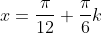 . A common mistake on A is not including the plus or minus when the right side is squared. For b, the four answers are
 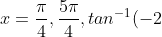+2\pi, tan^{-1}(-2)+\pi "x=\frac{\pi}{4},\frac{5\pi}{4}, tan^{-1}(-2)+2\pi, tan^{-1}(-2)+\pi")
Then we went over the homework. The first problem we went over was #33. On this problem we used the Squaring both sides method from page 393. This method squares both sides which allow you convert it to a quadratic type, which is easier to solve. Other problems we went over were numbers 55, 73, and 75.
Then we looked at a new set of identities. These are called the sum, difference, double and half angle identities. THESE IDENTITIES DO NOT NEED TO BE MEMORIZED. We will have access to them during quizzes and tests.
The six identities are:
Cos(a-b)=Cos(a)Cos(b)+Sin(a)Sin(b)
Cos(a+b)=Cos(a)Cos(b)-Sin(a)Sin(b)
Sin(a-b)=Sin(a)Cos(b)-Cos(a)Sin(b)
Sin(a+b)=Sin(a)Cos(b)+Cos(a)Sin(b)
Tan(a-b)=
Tan(a+b)=+Tan(b)}{1-Tan(a)+Tan(b)} "\frac{Tan(a)+Tan(b)}{1-Tan(a)+Tan(b)}")
These identities are also located on the front cover of your book
Towards the end we went over and corrected the quiz.
Homework p. 404/5, 19, 29, 33, 37, 47, 53, 63, 65, 71 [these questions should be answered without the use of technology, but be sure to use our new identities!]
Everyone has scribed 3 times now so someone will have to step up next class
Keegan
Then we went over the homework. The first problem we went over was #33. On this problem we used the Squaring both sides method from page 393. This method squares both sides which allow you convert it to a quadratic type, which is easier to solve. Other problems we went over were numbers 55, 73, and 75.
Then we looked at a new set of identities. These are called the sum, difference, double and half angle identities. THESE IDENTITIES DO NOT NEED TO BE MEMORIZED. We will have access to them during quizzes and tests.
The six identities are:
Cos(a-b)=Cos(a)Cos(b)+Sin(a)Sin(b)
Cos(a+b)=Cos(a)Cos(b)-Sin(a)Sin(b)
Sin(a-b)=Sin(a)Cos(b)-Cos(a)Sin(b)
Sin(a+b)=Sin(a)Cos(b)+Cos(a)Sin(b)
Tan(a-b)=
Tan(a+b)=
These identities are also located on the front cover of your book
Towards the end we went over and corrected the quiz.
Homework p. 404/5, 19, 29, 33, 37, 47, 53, 63, 65, 71 [these questions should be answered without the use of technology, but be sure to use our new identities!]
Everyone has scribed 3 times now so someone will have to step up next class
Keegan
Wednesday, April 7, 2010
4/7/2010
Today we started off with a little quiz on 5.1 and 5.2. The back page was a little tricky.
)
%3D53%2B50sin(%5Cfrac%7B%5Cpi%7D%7B16%7D(t-8)))


(u-1)%3D0)

 at
at  and
and 
 at
at 


 ,
, 

%3D0)


%5E2%3D(1-tanx)%5E2)


 and
and ) .
.
Then we got to look at all the Quarter 3 projects from R3 and W2. Mr. OB was right, Andy's was very entertaining.
We got to go over some problems from last class's homework on page 396: 5, 21, 33, 35, 56, 68, & 75.
The goal of last night's homework was to get us to practice solving them only with technology. Then we will practice solving them entirely without technology.
33) csc(x)+cot(x)=1 (enter into calc as %7D%20%2B%20%5Cfrac%7Bcos(x)%7D%7Bsin(x)%7D) and set scale to pi/12, domain )
and set scale to pi/12, domain )
Be careful when entering cotangent into the calculator, it should be entered as cos(x)/sin(x), not 1/tan(x) which is undefined to the calculator.
Answer:  , (funny looking Z that wasn't on the equation editor)
75) %3D53%2B50sin(%5Cfrac%7B%5Cpi%7D%7B16%7Dt-%5Cfrac%7B%5Cpi%7D%7B2%7D)) Factor....
Factor....
a) So, at 8 seconds and 24 seconds it is 53 ft above the ground.
b) During 160 seconds, the person will be at the top after 16, 48, 80, 112, and 114 seconds.
We can then confirm this on a calculator and set limits/scale.
Solving with Algebraic Methods:
5) Use the unit circle when solving algebraically, it's quite helpful to check your work.
If you have to solve this... begin by factoring:
Let sinx=u
This is when you would use the Unit Circle:
21) 
Factor out a cosx...
and
You can than look at the unit circle to see where cos is equal to 0, 1, and -1.
Or, if you prefer a graphical analysis, you can look at the graph of a cosine wave and see where the graph is at 0, 1, and -1.
**28) This was not on the homework but Mr. OB thought it would be a good one to go over in class.
Separate the sec and the tan on separate sides and square...
Factor...
and since we know that  through the pythagorean identity, they cancel on both sides to get...
and tan equals 0 at...
However, if we evaluate this on a calculator and check the values on the table, we can see that pi does not work - it is an EXTRANEOUS SOLUTION, that comes from squaring both sides in the beginning of the process. We must always remember to check our answers before moving on. As Mr. OB says, "It's like brushing your teeth and flossing. You can't get away without it"...
35)  This is considered a multiple angle function because the 2 shrinks the period of the function to pi, meaning there are more revolutions in a 2pi segment. We know that cos is equal to 1/2 at pi/3 and 5pi/3, so:
However, then we divide by 2 to get...
As well as these two coterminal angles...
56) This was an example of when you'd have to use the quadratic formula (yes, it's back).
let u=tanx
a=3, b=4, and c=-4
So, simplify and set equal to tanx...
However, for this one we have to use arctan to single out x...
For some helpful resources:
The Unit Circle: http://www.dudefree.com/Student_Tools/materials/precalc/unit-circle.php
The Quadratic formula: http://www.purplemath.com/modules/quadform.htm
HOMEWORK: HW #4:
* p. 396/11, 17, 23, 25, 29, 33, 37, [these should be answered using technology], 55, 61, 69, 71, 73, 77
REMINDER: Try to get all caught up on your homework, it's really important for the quizzes!
Next Scribe: Keegan
Subscribe to:
Comments (Atom)
